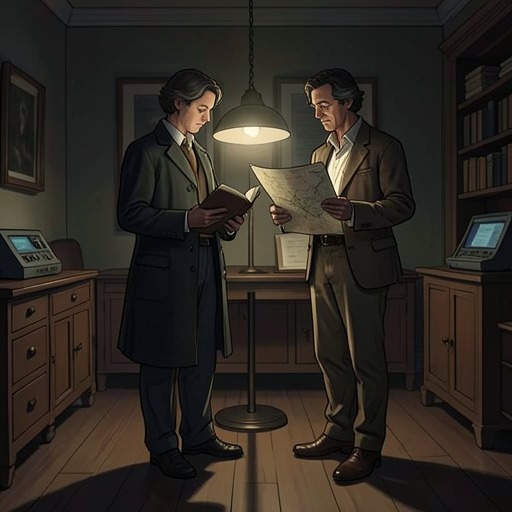
Tommy proposes the gallery and deferral theory
Never Let Me GoTommy proposes the gallery and deferral theory as an explanation for why Madame collected student artwork and as a possible route to extra time for couples who were truly in love. In a conversation with Kathy H. on a coastal walk, he joins the Donation Deferral Rumor circulating among veterans to Hailsham’s Gallery and its claim that art revealed its makers’ inner selves. The theory gives new meaning to a familiar childhood practice, but its personal stakes are severe: Tommy suspects that he may have lost a chance he did not know he had. A later explanation by Miss Emily establishes that the artwork served a different purpose.
Origins in Hailsham’s Exchanges
Tommy’s reasoning draws on a childhood world in which art had a visible place in the students’ everyday economy. At Hailsham, Exchanges took place four times a year, after students had spent three months making paintings, drawings, pottery, or sculptures from whatever materials were in fashion. Guardians assigned each work a number of Exchange Tokens; students then used those tokens to acquire work made by others in their own year. The Exchanges were one of the few ways students could build personal collections, filling wooden chests with objects to display or carry between rooms.
That system also made creative ability part of the school’s social currency. Students learned to value what they made and to notice how much esteem was attached to producing work others wanted. In Tommy’s recollection, the Gallery raised a related but more troubling question: why did Madame take away some of the best work? The practice had initially seemed an honour, but by the time students were ten, pride in having work selected had begun to conflict with the sense that they were losing possessions with market value. The disagreement became the tokens controversy, when some students argued that they should receive tokens to compensate for work Madame removed.
The dispute brought Roy J. to Miss Emily, the head guardian, to ask why Madame took their work. Tommy remembers Miss Emily’s explanation that the students’ art revealed what they were like inside, and that their pictures and poetry revealed their souls. That remark becomes the key piece of evidence in his later interpretation. The collection, he reasons, might do more than preserve or display childhood work: it might let someone assess the students through what they had created.
The theory on the coastal walk
Tommy raises the idea while walking with Kathy H. after they leave a shop. Chrissie and Rodney, he says, are convinced that couples who are genuinely in love can have their donations deferred. They believe the Hailsham students know about this arrangement, although Tommy recalls no such discussion at school. He links the rumor to veterans, and suggests that people such as Ruth have helped keep it alive. His manner leaves Kathy unsure whether his remarks about Ruth carry affection or disapproval, but he soon makes clear that he has been thinking about the rumor seriously.
For Tommy, a Deferral would require someone to distinguish lasting love from a couple’s strategic claim, a temporary crush, or sexual attraction. He imagines that Madame, or another decision-maker, would need evidence on which to base that judgment. The Gallery could supply it: Madame might compare work made by two students over many years and decide whether their inner selves matched. In this account, the collected pictures become a record of character, and artistic creation becomes a means of verifying love.
Kathy H. recognizes the connection Tommy is making between Miss Emily’s remark and the Gallery, but she does not confirm that his conclusion is true. She recalls Laura’s drawing of her intestines, a comic contrast with the grand idea that the students’ work could reveal their souls. She allows that Tommy’s explanation could account for what Miss Emily said and for the guardians’ insistence that students learn to paint. The exchange therefore presents the theory as a plausible reconstruction of incomplete childhood explanations, not as established knowledge.
The personal cost of the hypothesis
The theory changes the meaning of Tommy’s childhood exclusion from creative recognition. He concludes that Hailsham students had a special chance, and that work not placed in the Gallery might have represented a chance thrown away. He tells Kathy H. that, if his reasoning is right, he may have blown his opportunity. When she asks whether he ever had work taken for the Gallery, he shakes his head and describes himself as useless at art. He also remembers Miss Lucy’s earlier reassurance that his lack of artistic ability did not matter, but now suspects that she had comforted him rather than told him the truth.
That fear follows from the conditional structure of the theory. Tommy has no assurance that a Deferral exists, that Madame’s collection is used to evaluate couples, or that his own work would have affected the outcome. Yet each possibility becomes emotionally consequential once he imagines the Gallery as an application archive. What had seemed a mystery about childhood artwork turns into a retrospective judgment on his chances. His joking recognition that he may have missed out does not erase the anxiety beneath it.
The idea also helps move the characters toward action. Ruth later gives Tommy a crumpled piece of paper bearing Madame’s address, saying that he should keep it for when Kathy H. changes her mind and that he must at least try. Her gesture turns the abstract theory into a possible visit, while leaving its truth unresolved. The address is not proof of a Deferral; it is a way to pursue the possibility Tommy has constructed from the evidence available to him.
What the Gallery was for
When Kathy H. and Tommy later speak with Miss Emily, her account overturns the proposed explanation. She says that even when Hailsham and its allies had been most influential, granting a Deferral would have been beyond their power. She explains that the artwork was collected and selected for special exhibitions as part of a public campaign: the displays were meant to demonstrate that students raised in humane, cultivated surroundings could be as sensitive and intelligent as ordinary human beings.
Miss Emily describes the movement’s public work, including large events attended by cabinet ministers, bishops, and other prominent people, where speeches were made and funds pledged. The Gallery’s purpose was not to compare the work of lovers or decide which couples merited extra time. It was to make the students’ humanity visible to a society that had treated clones as instruments of medical science. The paintings and poems mattered, but the theory Tommy builds from them is mistaken about who used them and to what end.
The episode turns on the difference between evidence and inference. Miss Emily’s words about art revealing the students’ inner selves are real, as is the removal and preservation of their work; Tommy’s account of a romantic assessment process is an attempt to connect those facts to the Donation Deferral Rumor. Its emotional force comes from that gap: a theory can offer hope and intensify regret even before anyone verifies it. The later explanation restores the Gallery’s political purpose while confirming that Hailsham’s efforts to protect and advocate for its students did not extend to securing the Deferral Tommy imagined.